
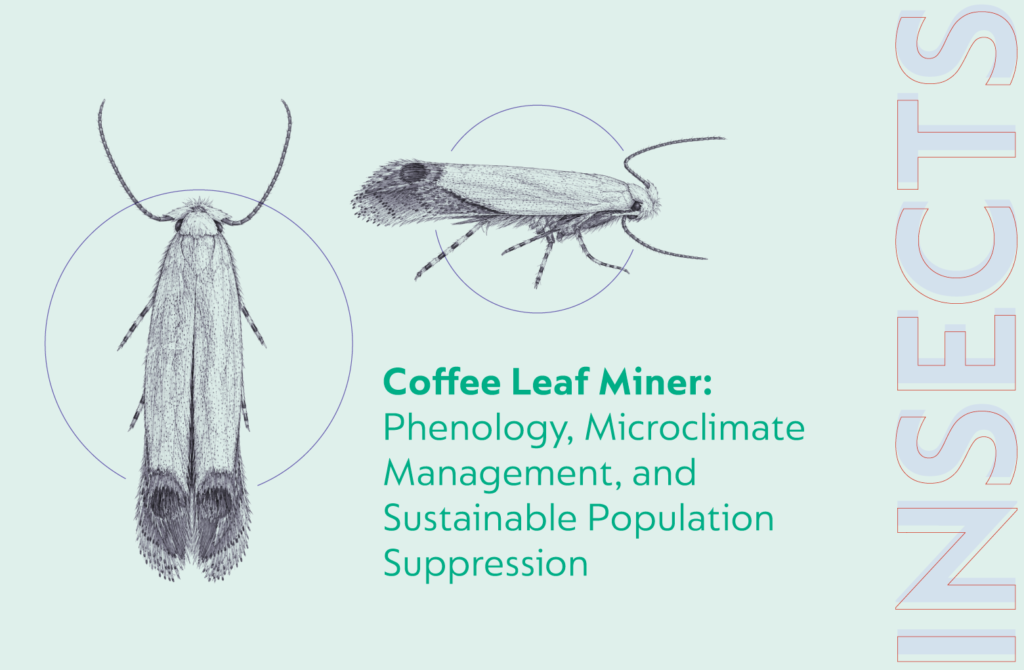

Welcome. This course delivers an advanced agronomic curriculum on the population dynamics, behavioral ecology, and sustainable management of the coffee leaf miner (Leucoptera coffeella). Developed for agricultural engineers and technical managers working in warm, low-elevation, or full-sun production zones, this training establishes practical protocols for economic threshold monitoring, biological control conservation, resistant germplasm deployment, and agroforestry microclimate manipulation.

Leucoptera coffeella is an obligate, monophagous microlepidopteran pest capable of causing up to 75% premature defoliation and direct crop yield declines reaching 87% in high-infestation regions. Managing this pest presents two complex technical challenges:
- Endophytic Larval Feeding and Accelerated Chemical Resistance: The larvae complete four developmental instars completely concealed inside the leaf’s palisade parenchyma, destroying photosynthetic tissue and leaving dead necrotic lesions. Decades of calendar-driven neurotoxic sprays (organophosphates, pyrethroids, and neonicotinoids) have led to documented field resistance against active ingredients such as chlorantraniliprole, chlorpyrifos, and thiamethoxam, while escalating production costs.
- Microclimatic Vulnerability and Biocontrol Disruption: Warm temperatures and prolonged dry periods accelerate the pest’s life cycle (from 50 days at 19°C down to 16–19 days at 35°C), triggering explosive population spikes in unshaded monocultures. Concurrently, broad-spectrum chemical sprays eliminate natural enemy populations—eradicating native parasitoid complexes that naturally provide 58% to 89% pest mortality in undisturbed systems.
The core objective is to transition from blind calendar spraying to threshold-driven decisions supported by pheromone surveillance, natural enemy conservation, and plant genetic resistance.

By completing this course, you will be able to:
- Operate Semiochemical Trapping and Threshold-Based Monitoring: Calibrate spatial networks of sex pheromone traps (5,9-dimethylpentadecane) and field scouting protocols to trigger interventions strictly at the 11% Economic Threshold (ET).
- Prescribe Biorational and Resistance-Mitigating Controls: Select and rotate ovicidal treatments, botanical extracts, and biorational insecticides while phasing out high-risk neurotoxic active ingredients.
- Integrate Genetic Resistance and Conservation Agroforestry: Deploy pest-resistant coffee cultivars and introduce extrafloral nectar-bearing trees (Inga spp., Senna cernua) to maximize conservation biological control by native parasitoids and predators.
